AI and Employee Productivity in Consultancy
Artificial intelligence is rapidly reshaping professional services, influencing everything from workforce planning and employee development to project delivery and profitability.
For consultancy firms, the discussion is no longer centred on whether AI will affect the workplace. Instead, organisations are increasingly focused on understanding how AI will change the way consultants work, how projects are delivered, and which skills employees will need to remain productive in the years ahead.
While AI has the potential to automate routine tasks and improve efficiency, recent industry research suggests many firms are still navigating significant challenges when it comes to workforce readiness, employee training, and scaling AI adoption across the organisation.
The Growing Gap Between AI Ambition and Workforce Readiness
According to McKinsey’s 2026 HR Monitor, organisations are facing several structural gaps as they prepare for an era of human-AI collaboration.
The report found persistent disconnects between operational planning and long-term workforce strategy, employee expectations and organisational responses, as well as AI experimentation and enterprise-wide implementation.
As McKinsey notes rapid advances in automation, that only 11% of organisations surveyed reported taking a long-term approach to workforce planning. At the same time, demand for AI-related capabilities and people-centred skills continues to grow as routine task-based work becomes increasingly automated.
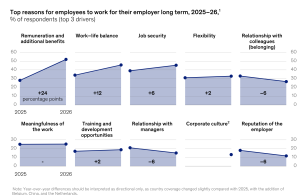
Image source: McKinsey & Company
For consultancy firms, this presents a challenge. Project success has traditionally relied on a combination of technical expertise, industry knowledge, and effective resource planning. As AI changes how work is performed, firms must ensure employees have the skills required to adapt to new delivery models.
The research also highlights concerns around employee development. Many organisations acknowledge that AI will reshape work, yet investment in training and capability building has not always kept pace with the rate of technological change.
This raises important questions for professional services firms: if project delivery is evolving, are employees receiving the support they need to evolve with it?
Is AI Replacing Talent or Enhancing It?
The impact of AI on consultancy employment remains the subject of ongoing debate.
One perspective suggests that automation may reduce demand for some of the routine tasks traditionally performed by junior consultants. Activities such as research gathering, data analysis, documentation, and report preparation can increasingly be supported by AI tools, potentially reducing the number of hours required to complete certain project activities.
However, others argue that AI is enhancing employee productivity rather than reducing the need for talent.
Christoph Schweizer, CEO of Boston Consulting Group, has highlighted the growing value of AI-native employees entering the profession. According to Schweizer, younger consultants are often highly comfortable working alongside AI tools and are incorporating them into their daily workflows in ways that accelerate learning and improve efficiency.
This perspective suggests that AI may enable consultants to contribute value earlier in their careers by reducing administrative effort and allowing more time to focus on analysis, client engagement, and problem-solving.
Rather than viewing AI as a replacement for employees, some firms are viewing it as a productivity multiplier that enables project teams to deliver more value within the same amount of time.
The reality may lie somewhere between these two viewpoints. While AI can automate certain activities, the demand for human judgement, relationship management, communication, and strategic thinking remains central to consultancy work.
Why Are Some Consulting Firms Still Reducing Headcount?
At the same time that organisations are investing in AI, several large professional services firms have announced workforce reductions, hiring slowdowns, or reduced graduate intake.
This has led to questions about whether AI is contributing to lower demand for consultancy talent. However, attributing these changes solely to AI would oversimplify a complex market environment.
Consulting firms are also responding to broader economic factors, including reduced client spending, changing project demand, margin pressures, and ongoing organisational restructuring. In many cases, firms are balancing investments in AI with efforts to improve operational efficiency and adapt to evolving market conditions.
As a result, the relationship between AI and employment is not straightforward. While some tasks may require fewer hours to complete, organisations are simultaneously seeking new skills related to AI implementation, automation governance, data analysis, and digital transformation.
From AI Adoption to AI Fatigue
Another emerging trend is the shift from AI experimentation towards measurable business outcomes.
Industry research suggests many organisations are entering a period sometimes described as “AI fatigue.” After an initial wave of enthusiasm and experimentation, business leaders are increasingly focused on understanding where AI delivers tangible commercial value.
Across professional services, return on investment remains a board-level priority.
AI, automation, and advanced analytics are expected to remain important components of future business strategies, but organisations are increasingly looking for evidence that these technologies improve project outcomes, increase delivery efficiency, enhance quality, or strengthen profitability.
In this environment, AI adoption alone is unlikely to be enough. Firms must demonstrate that technology contributes to measurable business results.
What Does This Mean for Consultancy Projects?
The greatest impact of AI may ultimately be felt within project delivery.
Many project-based activities that once consumed significant consultant time can now be completed more efficiently with AI assistance. Research, documentation, meeting summaries, reporting, and administrative workflows are increasingly being automated or accelerated.
This creates opportunities to improve project productivity, reduce administrative burden, and allow consultants to focus on higher-value activities. However, these benefits are not guaranteed.
Without clear processes, employee training, and effective workforce planning, AI risks becoming another disconnected technology initiative rather than a meaningful driver of project performance.
The firms most likely to benefit are those that successfully combine technology investment with employee development, project governance, and capability building.
Looking Ahead
The future of professional services is unlikely to be defined by AI replacing consultants. Instead, it is increasingly being shaped by how effectively organisations combine human expertise with technological capability.
Research from McKinsey highlights ongoing challenges around workforce readiness, skills development, and scaling AI adoption. Meanwhile, industry leaders such as Boston Consulting Group point to the growing value of AI-native talent entering the workforce.
At the same time, economic pressures, organisational restructuring, and evolving client expectations continue to influence hiring decisions across the consulting sector.
Taken together, these trends suggest that AI’s impact on employee productivity is not a simple story of job creation or job displacement. Rather, it represents a broader transformation in how consultancy firms deliver projects, develop talent, and create value for clients.
Key Takeaways
- AI is reshaping project delivery across professional services.
- McKinsey’s research highlights significant gaps between AI ambition and workforce readiness.
- Many organisations continue to face challenges around training, skills development, and scaling AI adoption.
- Some industry leaders believe AI-native employees can enhance productivity and accelerate project delivery.
- Workforce reductions across parts of the consulting sector cannot be attributed solely to AI, as wider economic and market factors are also influencing hiring decisions.
- Organisations are increasingly shifting from AI experimentation towards measurable commercial outcomes.
- The future of consultancy projects is likely to be defined by human-AI collaboration rather than complete automation.